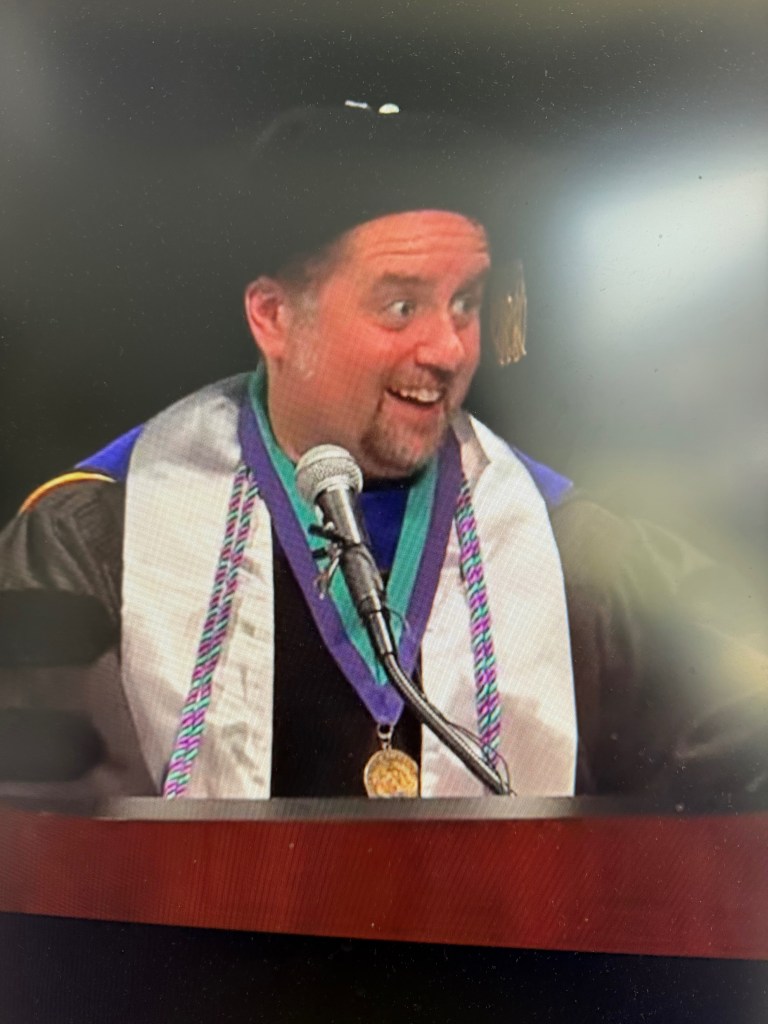
I gave the faculty commencement speech at the College of Education’s undergraduate graduation ceremony last week. Here are the words I shared with what felt like a very large audience:
***
It’s an honor to be with you all. There are remarkable people on this stage that I care about a great deal. And in this audience. I’ve come to admire the University of Iowa’s College of Education. This is saying something for a graduate of The University of Minnesota. Ski-U-Mah aside, I’m proud to be amongst you tonight.
But enough about you. This is my speech. So here is something about me.
Did you know I’m a best-selling author? And by best-selling, I mean worst-selling. I’m finishing a new book with my friend and colleague Dr. Erin Miller that will likely make a splash on the New York Times best-seller’s list. And by likely, I mean not likely.
Our book is about teaching and learning. Erin was an elementary teacher and I was a high school teacher. And now we are both professors. We tell stories from our careers to think about how teaching and learning are and should be about transformation. I want to read a little from this book to you tonight because you are a captive audience. And maybe you’ll leave this auditorium and buy 30 copies of my books. Or 300. I’m kidding. Mostly. I want to read this story to you because teaching and learning are hard and transformation matters as much as anything else in the world.
I really like the working title for the book. How to Transform in 10-Billion Excruciatingly Difficult Steps: An Unhelpful Guide to Teaching and Learning. Don’t be fooled by people who tell you teaching and learning aren’t excruciating. Transformation is hard. Transformation is worth it.
Here is a little from my book:
To learn is to change.
These words interrupt my walk through the woods near the Mississippi River. I am twenty-three and it is the summer before my first year as a high school teacher. I am anxious about teaching in the fall. I suspect some of you are anxious about next fall. My anxiety brings me to paths I walk with Dad when I am little.
I am lost. I am drifting. I hear to learn is to change and it occurs to me that to teach is to change people. I always remember this walk.
Twenty years after my walk, I am a professor of education and listening to my friend Gail Boldt give a talk about her research at a literacy conference in Atlanta. Gail tells a story about her mother dying from cancer while she is an elementary teacher in Hawaii. Gail tells her students about her mother and a girl tells Gail to sit on the carpet. The student finishes reading Sadako and the Thousand Paper Cranes and, thirty years later, emails Gail to tell her how important that moment was. Gail shares this story to a room of educators and scholars so that we might understand most learning, most change, and most of the things that affect us have less to do with teachers, curriculums, or texts and more to do with how we experience energy, vitality, and potential. Gail suggests that vitality is uncontrollable potential energy between people that can be unlocked through encounters with difference. Gail’s claim that difference produces movement, change, and learning brings me into relationship with the totality of my experiences as a teacher and learner, and I am surprised to be crying at a literacy conference in Atlanta.
I do not have Gail Boldt’s words when I am twenty-three, but I do have words that come to me on my walk through the woods. The words come back to me as I write this sentence over twenty years later:
To learn is to change.
How do people change?
How can teachers help people change in meaningful ways?
These questions keep mattering to me. I hope you think about them as you go from this graduation. Here is another brief story that comes to me as I think about vitality and change.
It is the final day of the semester at Primville Area High School. High school students in the drama workshop class I am teaching are moving desks back into my classroom to replace the folding chairs we moved in earlier to make room for audiences to watch our original play. Students put on the play for their peers during the final week of classes. This class is full of different kinds of people. The people in this class were dissimilar. The people in your classes will be dissimilar too.
I stand near my desk that morning, organizing the space that had served as our backstage.
“Mr. Tanner!” Alexa calls out to me from across the room.
“What, Alexa?” I shout above the noise of the other students.
“We should have a dance party!”
I laugh. I’m not a dancer. I don’t think many of the other students in class are dancers either.
“Okay,” I say with a shrug.
Alexa walks to the makeshift tech booth in the back of our classroom. She cues a pop song from our play. Alexa turns up the volume. Finally, she shuts off the fluorescent classroom lights. Alexa turns on the stage lights.
“Dance party!” Alexa shouts
I watch, from across the room, as forty high school students begin to jump up and down and shout with joy. I am bewildered. The same forty students that entered my class three months ago with skepticism and even hostility now, without prompting from me, are having a dance party together. Nobody is standing off to the side. The dance party goes on long enough to surprise me. The bell rings, the dance is over, and students filter back into the hallways, never to join together in the same way again.
I think to myself that this strange dance party matters deeply, but I am not quite sure why. Students are so alive as they dance together and that life matters.
Twenty years after this dance party, I receive a Facebook message from Lauren as I am working on this book. Lauren is a student in a drama class I teach at Cardinal. Lauren writes that she was talking about me with a friend the other day.
“You literally got me through my senior year of high school,” she writes. And then she credits my drama class with helping her survive her best friend’s suicide. She writes “I hope you know that your class literally kept me going.”
What about that class, I think to myself, could possibly matter enough to Lauren to help her stay alive? I wish I had answers. I don’t.
And here I want you to know that I am joking. I do think there are answers to my questions. But those answers are complicated. Life is complicated. Transformation is complicated. Growing our capacities to transform along with others matters as much as anything else. And I hope you’ll figure out how that matters in your own many scary worlds—both as teachers and learners.
A week after getting Lauren’s message, I’m teaching a doctoral seminar at the University of Iowa. The class is called Improvisation, Pedagogy, and Social Change. Graduate students have finished leading public facilitations. The process they went through reminds me of Drama Workshop.
Without intending to, I tell students about Alexa’s dance party and Lauren’s Facebook message. Suddenly, I am crying. I do not know why.
“All I know for sure is that the dance party mattered,” I say to my graduate students. I am surprised that some them are crying as well. “And what we are doing here matters too.”
There is vitality in this moment. A sense of aliveness that I cannot totally explain with words. And that vitality matters.
Let this story be my humble offering to you tonight. I hope you will experience vitality in whatever comes next. I hope you will facilitate and participate in dance parties, whatever those dance parties might be. There is no simple formula, but paying attention to whether or not you are cultivating or stifling vitality matters. So pay attention, face your many scary worlds, and keep transforming no matter what happens.
Thank you.

