As a teenager, Dad dragged me Woodland Hills, a church led by the charismatic and heretical Dr. Gregory T. Boyd. Waking up for church was annoying, and I wasn’t about to wave my hands around or sing. Still, Greg sermons were strange – they were unlike the countless other churches (and synagogues) Dad dragged me to as a child. Woodland Hills provoked me to think hard about the universe and my place within it. I have to imagine Greg’s sermons affected me as I sat in the audience, running my hands through my luxurious long hair, pretending to be Kurt Cobain. Or Neil Young.
And then thirty years went by and a podcast from Woodland Hills appeared on my phone. Apparently, Woodland Hills was still providing thought-provoking sermons. And, after the murder of George Floyd, Boyd was openly speaking against white supremacy. I was annoyed with the increasingly nationalistic church our Black neighbors invited us to when we moved to State College, so my wife Katie and I started attending Woodland Hills virtually on Sundays instead. Eventually, Katie and I enrolled in Woodland Hills’ online seminary program, SEM. Two-and-half hours on Tuesday nights. One-and-a-half hours on Sunday morning. I didn’t have time for that. And yet we made time for it.
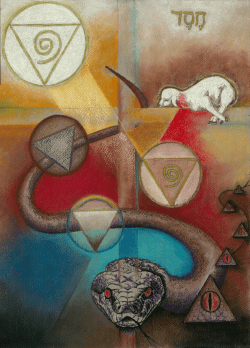
The image above is a piece of work created by Maree Frost, one of the students in SEM. This art was what she chose to do for her final project. She is from New Zealand. I often wish I was from New Zealand. Kia ora, baby.
The image is wild. The piece of art, amongst other things, depicts the way that evil destroys itself. The serpent eats its own tale. Empire always collapses. That message seems important. That message reminds me of a song by one of my heroes, Neil Young.
***
Neil’s career was fizzling out in the 80’s. In his late thirties, he recorded a couple of albums that were almost parodies of themselves. I imagine his money was running out. And then it was 1989, Neil was 44, and he released the strangest album.
Freedom was one of the first CD’s I bought. I must have been twelve or thirteen. The album, as I wrote about a few months ago, was an amalgam of genres. Neil was quoted as saying “he wanted to make a real album that expressed how he felt. There was no persona or image.” Rockin’ in the Free World is a real and abrasive song on the album. The song, in part, was a reaction against Reagan’s America. A reaction against American empire. The song isn’t melodious and, really, it doesn’t sound all that good. Neil never seemed to worry about sounding good. Instead, it seems to me that at his best Neil was after vulnerability – he was about being real. In the song, Neil leaned into his anger, leaned into his hope, and just let it fuckin’ rip. I admired that as a kid. I admire it so much more, now that I’m 44 too. How difficult it is to be vulnerable as we get older. To be real. To lean into anger, lean into hope, and just let if fuckin’ rip.
I wanted to touch some of Neil’s authentic energy with my final project for SEM this year. So I decided to rewrite and record a cover of Neil’s song as a rumination about rejecting empire.
***
Like Neil when he wrote Rockin’ in the Free World, I’m 44 now. And I’m tired of so many of the personas or images I’ve cultivated for myself over the years. And I’m tired of being afraid to be vulnerable. I’m tired of hiding behind my self-deprecating sense of humor. Laughing at myself before others can. I am tired of being afraid of my anger, of trying to control things, of not letting it fuckin’ rip.
So I re-wrote Neil’s lyrics. I turned them into Sam’s lyrics. I work with a friend in a Pavement cover band. I borrowed one of his acoustic guitars. The strings were about 90 years old, but they sounded okay to me. I gave away my old Martin years ago. I never changed those strings either. I checked out a microphone from the tech department in my college.
“What’s it for?” the girl behind the desk asked.
“Recording,” I said sheepishly.
I sat at down at my computer to record the song on a Wednesday night. I did a couple of takes. I was so embarrassed by the sound of my voice. I turned up the reverb to disguise my high-pitched, out-of-tune drawl. Next, I went up to my son Solomon’s room. Maybe I could hide behind the cuteness of playing with my child.
“Do you want to play with me?”
Solomon is a piano virtuoso. He loves music.
“Sure,” he said. He listened to my recording. “Why does your voice sound like that? I can’t hear it.”
I told him it was because I sucked at singing. He told me I was fine. He told me to turn off the reverb. So I did.
Solomon and I did a few takes together. He played piano. I played guitar and sang. Father and son with our good friend Neil. The next day, I sent Katie a copy of the file in a text. But I accidentally sent the song to a friend I play basketball with at work. Somebody I don’t know very well. He promised me he deleted the song without listening to it. I can’t be sure. I was mortified. Embarrassed beyond all belief.
I took the guitar out again a few days later. Took three more takes. Convinced myself to sing louder. Didn’t hide behind my son or reverb. By draft seven, my fingers were peeling. Early callousing. It’s been years since I’ve played guitar regularly. Seven drafts of the song would have to do.
There are all sorts of things 44 year-old people do to get through the day. Lots of them seem a little off to me. Being vulnerable and touching some of Neil’s energy seems something to be proud of rather than ashamed about. Recording the song was an homage to my thirteen-year-old self who sang along with Neil in the loneliness of his room. I’m trying to convince myself I don’t care how the song sounds. I don’t care what people think of my voice. I don’t care about the amateur quality. I made something. There’s light in such a move. There’s love such a move. There’s rejection of empire in such a move. There’s Jesus in such a move.
The diminishment of difference is a term I’ve been thinking about lately. My therapist described the phrase to me as an experience when somebody misrecognizes somebody else by defining them with something in them. I think this happens all the time. People have diminished my difference in all sorts of ways over the last 44 years. “You’re so short!” “Your family is weird!” “Your jumpshot looks so strange!” “You are so funny, Sam!” These phrases often reveal more about the other person than they do me. Still, I usually laugh along when I am misrecognized, make a self-deprecating joke, and, eventually, to whatever extent I can, connect with the person. That’s been a fine way to live, but it has its shortcomings. One of the problems with feeding the diminishment of my difference is that it plays into personas or images that others have imposed on me, that might actually not be true. The diminishment of difference feeds deception. I certainly could have written a parody of Neil’s song. Tried to get in front of my shaky, weak, out-of-tune voice and make something with the intention of getting a laugh. But I always try to make people laugh. That wasn’t what I was after this time. You can laugh at the song all you want, but that’s not what I’m up to. In the words of one of my heroes Conor Oberst, I am not singing for you. In the words of one of my heroes Eddie Vedder, this is not for you.
The diminishment of difference is different than the affirmation of difference. Affirmations of difference can cultivate vulnerability, connection, and love. Those are things that matter to me most as I get older. I suppose I want to let go of diminishment of difference. I sound the way I sound when I sing. I look the way I do when I shoot a basketball. I am short. I don’t want to care how other people experience those things. Recording a cover of Neil’s song was about touching energy by building something. I built something and touched some energy with the belief that this was a good thing to do.
So here’s the song. Keep on rockin in the free world.
 Samuel Jaye Tanner