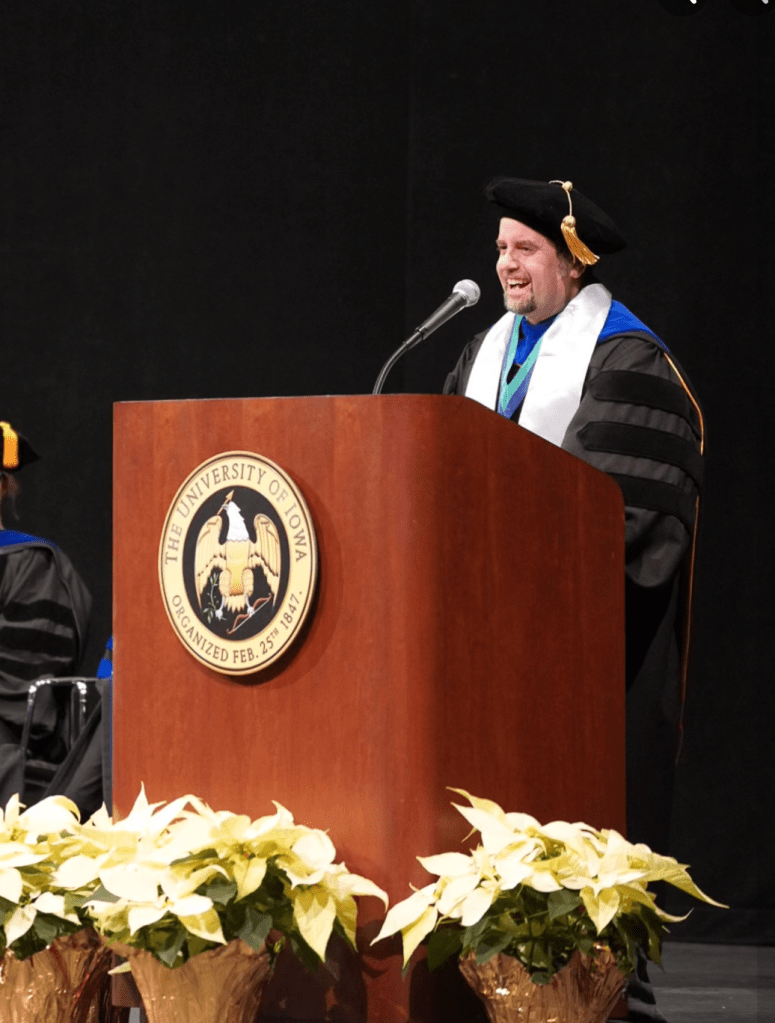
A few weeks ago, I wrote about being selected to give the faculty speech at the University of Iowa’s College of Education graduation ceremony. I did it last Thursday. I think it went well, though that picture of me above is a little disappointing. I look bulbous. And old. Anyway, I figured for this weekly blog, I’d share that speech. Kill two birds with one stone. Here’s the speech I gave to those fine students who graduated last week.
***
Greetings faculty, staff, parents, caregivers, and families. And a special greeting to our graduates. I’m honored to share some brief remarks with you.
Before I say anything more, I want to clear up some confusion. My esteemed colleague Dr. Mark McDermott has made much of the fact that I somewhat resemble Green Day’s Billie Joe Armstrong (I don’t see it). And, while it is true that I once served Billie Joe a cup of coffee at the Dunn Brothers in St. Paul in 2002, and the other baristas on duty did think we were doppelgangers, I want to assure that I am not now and have never been an American idiot.
I am, instead, an educator. In a room full of other educators, celebrating the induction of many future educators into what I think of as the most noble of professions. At the turn of the 20th century, John Dewey described teachers as prophets of democracy. In a talk Dewey gave as fascism was spreading across Europe in the thirties, Dewey argued the urgent task ahead is “to get rid of the habit of thinking of democracy as something institutional and external” and “to realize that democracy is a reality only as it is indeed a commonplace of living.” Dewey went on to describe the task of building democracy as “one that has to be carried on day by day” and that work must “go beyond what exists” and “continually open the way into the unexplored and unattained future” (p. 62). For Dewey, in the United States, it is a primary responsibility of a teacher to cultivate democracy with discipline in an improvisational quest after a future that cannot be predetermined.
I often tell teacher education students about Dewey. I also share the story I’m about to tell you. Why not get some new material? Well, this is the best I’ve got and this event celebrating the noblest profession seems the time to share the best I’ve got. So here’s a quick story.
Before I was a college professor, I was a high school English and Drama teacher. My first year of teaching was, unsurprisingly, difficult. That first year tends to be challenging. Teaching is hard. I was ready to pack it in and make a go of it as a freelance poet or the point guard for the Minnesota Timberwolves when I saw something important.
One morning, way back in 2003, I watched as a 9th grader built a house of cards on her desk during a study hall. This girl carefully added card after card until she had built a tower that was five-stories high. I can still picture her card house today. It was tremendous. Like so many others, I was mostly clueless during my first year of teaching, so I remember thinking about how profound this girl’s act of creation was. She built something remarkable in a chaotic, classroom space.
After the girl finished, a group of students across the room noticed what she had made. A boy threw something at the card house and destroyed it without stopping to think. His act seemed impulsive. Maybe even compulsive. Next, the students across the room started to build their own house of cards. Then the previously peaceful girl spent twenty minutes trying to knock down their card house across the room. The bell rang, students left, and cards were everywhere.
Something about this event devastated me.
Why did the boy feel the need to destroy the girl’s work? Why did she need to knock back? I spent lots of time thinking about this story. I came to understand it is as illustrative of the way people frequently interact with each other. All too often we give in to our destructive impulses and spend our time destroying the things others create. We hurt each other, rather than working together peacefully to build something. I have shared this story with every group of students I have since worked with. I have a simple message when I’m finished.
“We have a short time together,” I tell my students. “My challenge to us is that we don’t knock down each other’s card houses and, instead, build something together.”
This story is the heart of my teaching. The metaphor challenges me to consider how my actions might help or harm a group. I’d like to think it has the same effect on my students. If anybody is destructive or harmful to the group (including the teacher), it is our job to acknowledge the harm, and adjust so that it does not happen again. I’ve found that this story of card houses has provided me language to build affirmational and generative spaces with students in schools. Democratic spaces. I’ve built lots of cool things with students over the last twenty years and, graduates, I’m hopeful you’ll build cool things with your students. The certainly is a need right now for people who build things instead of people who destroy them. Just check Twitter.
My favorite author Kurt Vonnegut and fellow Hawkeye educator once wrote that anytime you build something your soul grows. How much more does your soul grow when you build something with others?
So yes, fellow educators, teaching is hard. But it is also soul-growing, noble work. And, according to Dewey, any chance we have for democracy is won or lost in the classroom. No pressure. Any advice I have for you is found in my story of card houses. Be people who build with other people – educators who build with their students – and there’s hope for all of us. Give in to your desire to control or destroy, and I can’t promise anything, though I worry that you, unlike me, might become an American idiot.
One last thing. Kurt Vonnegut also wrote about how important it is for us to notice when we are actually happy about something. Celebrate joy. You should be really happy about this moment in which you are graduating from college. Please notice it.
Thank you for humoring this humble educator and congratulations.
***
There’s my short speech. The lines about Green Day would have killed in 2006. I’d probably have looked less bulbous too. Or old. Not so much in 2023. Oh well. Time passes and now I’m the sort of person who gives speeches at graduation. Who knew?
 Samuel Jaye Tanner